


Introduction: The Real Cost of Brokerage in Dubai
You found the perfect apartment in Dubai Marina. The views are stunning, the price seems fair, and you are ready to sign. Then your agent mentions the commission, and suddenly, nothing feels clear anymore. How much should you pay? Who pays whom? And are you getting a fair deal?
This confusion is more common than you might think.

Dubai’s real estate market attracts buyers, sellers, and tenants from around the world. But the way real estate agent commissions work here stays hidden for many people. Unlike markets with fixed, government-regulated fees, Dubai gives room for negotiation and variation.
Here is what we know from current data. The standard commission on a property sale in Dubai usually lands at 2% of the purchase price. For rental transactions, expect to pay around 5% of the annual rent according to Engel & Völkers. But these numbers can shift depending on the property type, the brokerage you choose, and even the specific deal you strike. Some sources show the average real estate agent commission in Dubai ranging from 2% to 5%.
If you are a buyer, a seller, or someone renting real estate agent services, you need to know what these percentages actually mean for your wallet.
This guide breaks down typical commission rates, what they cover, and how to move through the process with confidence. We will look at who pays what, when costs change, and how the rules set by the Dubai Land Department and RERA protect you. Understanding these details helps you avoid costly mistakes and feel good about your next property move.
Think of this as your straightforward roadmap to the real cost of brokerage in Dubai.
Get your free Dubai real estate consultation today and talk through your specific situation with someone who knows the market inside out.
How Real Estate Agent Commissions Work in Dubai
Now that you understand the general cost range, let’s dig into how real estate agent commissions actually work. The simple version sounds nice: the seller or landlord pays the fee, not you. But the real story has a few more layers.
In Dubai, the standard rule is that the property seller pays the commission for a sales transaction. This means if you are buying a home, you often do not write a separate commission check to the agent. The seller covers that cost from the sale proceeds. According to Engel & Völkers, the typical commission for a property sale lands at 2% of the purchase price.
But here is the thing. That 2% does not always tell the whole story. Some real estate agencies charge slightly different rates. The realistic range for agent fees on a sale in Dubai spans from 0% for off-plan or direct developer deals to about 2.5% for premium full-service brokerages, as noted by Sands of Wealth. The average real estate agent commission charge in Dubai ranges from 2% to 5% according to Eastern Housing. So always ask upfront what percentage applies to your specific deal.
What About Rentals?
Rentals work differently. When you rent a property in Dubai, the tenant usually pays the commission. The standard amount is one month’s rent per year. That works out to about 5% of the annual rent for a one-year lease. For example, if your annual rent is AED 100,000, expect to pay around AED 5,000 as a commission fee to your real estate agent.
Some real estate agencies dubai charge between 5% and 10% for annual rental fees. This range depends on the property type, location, and the specific brokerage. The key is to clarify the commission amount before you sign any agreement or start viewing properties. You can also negotiate. Many agents are open to discussing their fee, especially if you are renting a high-value property or signing a longer lease.
Who Actually Pays?
Let’s clear up the confusion one more time. Buyers typically pay nothing directly in commission for a sales transaction. The seller pays the fee. For rentals, tenants pay the commission. Landlords do not pay rental commissions. This is a standard practice across the market, but you should confirm it with your agent before moving forward. Different real estate agencies dubai may have slight variations in their policies.
If you want a quick breakdown, here is a simple table:
| Transaction Type | Who Pays Commission | Typical Commission Rate |
|---|---|---|
| Property Sale | Seller | 2% of sale price |
| Property Rental | Tenant | 5% of annual rent |
A Note on Negotiation
Commissions in Dubai are not set in stone. You can and should ask about the fee. The market is competitive, and many agents will work with you to reach a fair number. This is especially true if you are a repeat client or bringing a high-value deal. Do not be shy about bringing up the topic early in your conversation. A good agent will be transparent about their fees from the start.
Understanding these basics helps you budget correctly and avoid surprises. If you are ready to take the next step, connect with Ayaz Salman for a free consultation and get personalized guidance on your specific transaction.
The Full Role and Responsibilities of a Dubai Real Estate Agent
So you know the commission rules. But what are you actually getting for that fee? A good real estate agent in Dubai does far more than just open doors and show you around. Their job starts long before the first property tour and continues well after you sign the contract.
Think of a professional agent as your guide, negotiator, and safety net all in one. Their core responsibilities go deep into the entire transaction process.
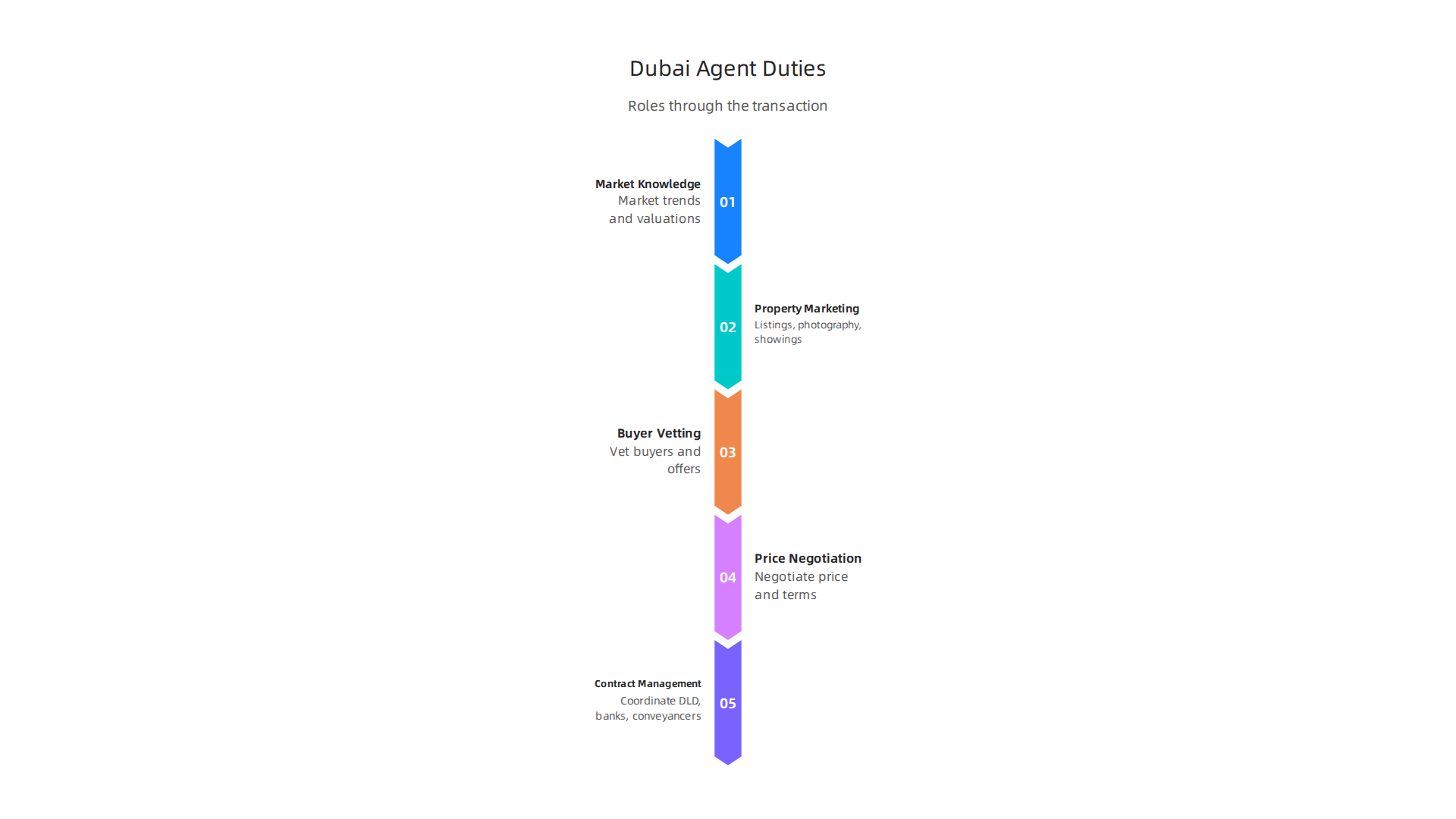
According to KEstates, agents must have intimate knowledge of the local market. They analyze market trends, perform property valuations, and understand what makes a particular area valuable. When a seller lists a home, the agent handles the marketing, photography, listing placement, and showing coordination. When a buyer comes in, the agent vets the property, runs comparable sales data, and prepares a fair offer.
Then comes negotiation. A skilled agent protects your interests during the back-and-forth on price, payment terms, and any special conditions. They also manage the contract process from start to finish, coordinating with the developer, bank, conveyancer, and Dubai Land Department as needed.
RERA Licensing Matters Here
You might wonder who gets to call themselves a real estate agent in Dubai. The answer is strict. Every licensed agent must be registered with the Real Estate Regulatory Authority (RERA).

This is not optional. The government requires agents to pass specific exams, complete continuing education, and renew their credentials regularly.
A licensed real estate agent provides assurance that they meet Dubai’s high professional standards. To earn that license, agents must study UAE real estate laws, RERA regulations governing conduct, property valuation methods, and market analysis techniques, as explained in the guide to becoming a real estate agent in Dubai. They must also stay current with changes in the law through mandatory continuing education. This means your agent should know about the latest legal updates that affect your deal.
The Dubai real estate brokerage sector has grown significantly. According to Dubai Land Department data, brokerage commissions rose to AED 13.59 billion in 2025, a 31% increase. That growth reflects a more professional and regulated industry.
How Agents Protect You
The most important role an agent plays is protecting both parties in the transaction. A licensed agent ensures that all legal disclosures are made properly. They verify that the seller has clear title to the property. They confirm that the property is free of liens or legal disputes. They also guide you through the escrow process, making sure your money is held securely until all conditions are met.
When you work with a RERA-certified agent, you have someone who understands the legal framework and will not cut corners. If you are looking for a trustworthy broker to help with your next move, learning how to choose a real estate brokerage in Dubai that you can trust will save you time and stress.
Still unsure whether your agent is doing everything they should? Get a free consultation with Ayaz Salman to know what to expect from a professional brokerage and how to verify your agent’s credentials.
Dubai Real Estate Commission Regulations and Legal Framework
So you understand what an agent does and why their license matters. Now let’s talk about the actual rules that control how much they can charge you. Dubai does not leave real estate agent commissions up to chance.
RERA Sets Clear Commission Caps
The Real Estate Regulatory Authority (RERA) has established maximum limits.

For rental properties, the cap is 5% of the annual rent. If you are renting a place for AED 120,000 per year, your agent cannot charge more than AED 6,000. This rule protects both tenants and landlords from excessive fees.
For property sales, the commission cap is 2% under specific conditions. Many agents and brokerages negotiate their rates within this framework. The cap exists as a ceiling, not a floor. You should always ask what the commission includes and confirm it stays within legal limits. These rules are part of a larger system designed to keep the market fair. The Dubai real estate laws guide for 2026 explains how these caps fit into the broader regulatory environment.
Escrow Rules Protect Your Money
RERA also requires that all commissions be paid through licensed agents who follow strict guidelines. The money must often go through escrow accounts, especially for off-plan sales. This ensures your payment is held safely until the agent delivers the agreed services. The Dubai Land Department’s rules and regulations detail how these escrow requirements work. Agents must comply to keep their licenses active.
The Cost of Breaking the Rules
What happens if an agent ignores these regulations? The consequences are serious. The Dubai Land Department actively monitors compliance. In one major action, authorities fined 30 real estate companies for violations, with each company paying AED 50,000 for non-compliance.
Agents who break the rules can also face license revocation. That means they lose the right to work in Dubai real estate altogether. In extreme cases, there can be legal liability. The message is clear. Dubai does not tolerate agents who overcharge or cut corners.
If you want to understand more about how sales commissions work in practice, check out this guide on real estate agent sale commissions in Dubai.
Still unsure whether your agent’s commission is fair or legal? Get a free consultation with Ayaz Salman to review your situation and get expert advice.
Commission Breakdown: What You’re Really Paying For
Here is something many people miss. When you pay that commission fee, you are not just paying an agent to open a few doors.
That single fee covers a whole bundle of services and costs behind the scenes.
So where does your money actually go?
Marketing and Listing Costs
Your agent spends money before you even see a property. They pay for professional photography, sometimes even 3D virtual tours. They cover the cost to list your property on major portals like Property Finder and Bayut. These platforms charge agents fees for premium placements.
Agents also manage eye catching signage, brochures, and social media ads. All of this comes out of their pocket first. The commission you pay helps cover these upfront marketing expenses.
Market Analysis and Expertise
A good agent does more than just show homes. They research recent sales in the area. They compare prices and study market trends. This market analysis helps them price a property correctly or find you a fair deal.
According to the standard breakdown of real estate agent commission structures, agents use their local knowledge to give you an edge. They know which buildings have good management and which areas are about to grow in value. That insight takes time and experience to build.
Negotiation and Transaction Management
This is where a skilled agent earns their keep. They handle the back and forth negotiation with the other party. They also manage the paperwork, which in Dubai can be complex.
Agents check that all legal documents follow RERA rules. They coordinate with the Dubai Land Department and handle the transfer process. For rental deals, they draft tenancy contracts and ensure Ejari registration is done correctly.
Administrative Overhead
Every agent works for a real estate agencies Dubai. That brokerage has office rent, utility bills, software subscriptions, and staff salaries. The agency also pays for licenses, insurance, and compliance costs. Your commission covers a share of these operating expenses too.
The average commission in Dubai ranges from 2% to 5% depending on whether it is a sale or rental. But the exact amount can vary based on the property type and location.
The Agent’s Bottom Line
Here is the reality. Out of that commission you pay, the agent does not keep all of it. They typically split the fee with their brokerage. How much an agent actually takes home depends on their agreement. Many agents keep between 40% to 70% of the commission they earn. The rest goes to their company.
So when you see a real estate agent commission of 2% on a sale, know that the agent is only taking a portion of that. The rest covers all the costs we just discussed.
Understanding this breakdown helps you see the real value behind the fee. You can also spot when an agent might be offering minimal service for the same price.
If you want to compare how sale commissions work differently, read this guide on real estate agent sale commissions in Dubai. It explains what buyers and sellers actually pay.
Still unsure if you are getting good value for your commission? Talk to an expert who can review your situation. Get a free consultation with Ayaz Salman and find out if your agent’s fee is fair.
How to Negotiate Commission Fees with Dubai Agents
So you now know where your commission money goes. But can you actually push back on the fee? The answer is yes. Many people do not realize that real estate agent commissions in Dubai are often open to discussion.

Property owners who negotiate agent commissions can save a good amount if they do it right. It just takes knowing when and how to ask.
When You Have the Most Leverage
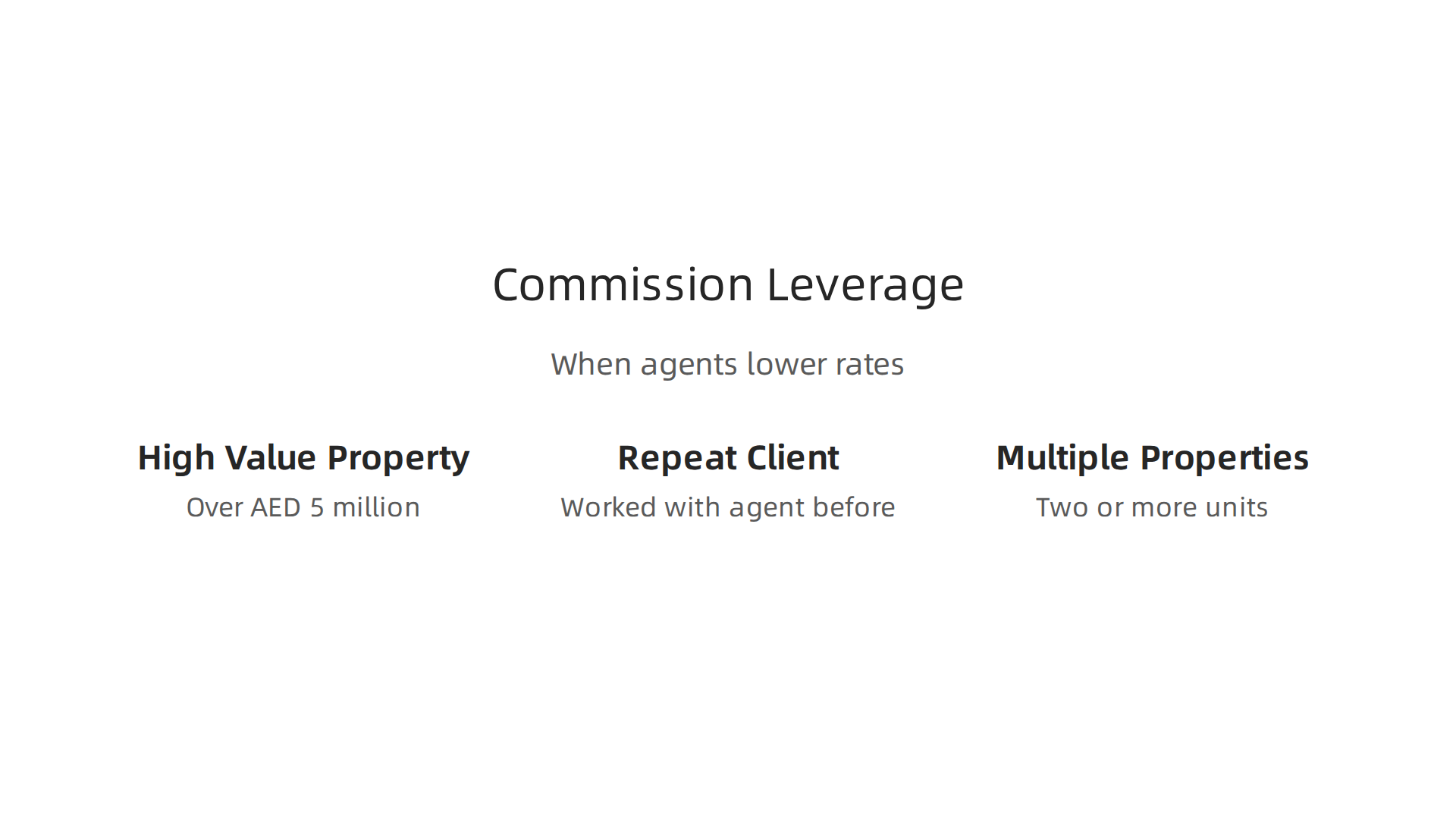
Agents are more willing to lower their rate in certain situations.
You have the best chance when:
- The property is high value. If you are buying or selling a villa over AED 5 million, agents often agree to a lower percentage.
- You are a repeat client. If you have worked with a renting real estate agent before, they want to keep your business.
- You have multiple properties. Buying or selling two or more units gives you strong bargaining power.
Smart Strategies That Work
Instead of just asking for a discount, try one of these approaches:
- Ask for a sliding scale. For example, 2% on the first AED 1 million, then 1.5% on the rest.
- Propose a flat fee. Sometimes agents prefer a fixed payment instead of a percentage on large deals.
- Bundle your services. If you use one real estate agencies Dubai firm for multiple transactions, ask for a package rate.
Watch for Red Flags
Before you agree to anything, get a detailed service agreement in writing. The contract should list every cost clearly. If an agent refuses to discuss the fee or tries to add surprise charges later, walk away. Good agents are transparent about their pricing.
Also check that the agency follows the rules. The Dubai Land Department has fined companies for not complying with regulations. Working with a compliant agency protects your money.
Negotiating your real estate agent commissions is not about being cheap. It is about making sure the fee matches the service you receive. A fair deal benefits both you and the agent.
If you want help finding an agent who offers clear and fair pricing, a free consultation can point you in the right direction.
Comparing Dubai Agent Commissions to International Markets
How does Dubai stack up against other countries? If you are used to property markets elsewhere, the numbers might surprise you. The short answer is that Dubai is often cheaper for buyers and sellers than many big global markets.
In the United States, real estate agent commissions are much higher. A 2026 survey found that total commission rates in the US typically range from 4.50% to 6.20% of the sale price. That includes what both the buyer’s agent and the seller’s agent earn. On a property worth AED 1 million, that could mean paying AED 50,000 or more in fees. In Dubai, a standard real estate agent commission for sales is just 2%. The difference is huge.
The UK sits somewhere in the middle. Estate agent fees there average between 1% and 3%. But here is the catch. In the UK, the seller usually pays the fee. And tenant fees for rentals have been banned in many cases. In some parts of Europe, you might see total commissions between 5.95% and 7.14% including VAT. That is far above what you pay in Dubai.
Even in nearby Saudi Arabia, the typical fee sits at 2.5% of the transaction amount. So Dubai’s 2% standard is competitive even within the region.
For renters, Dubai is especially simple. The typical cost is one month’s rent per year of the lease. This flat structure is clear and easy to understand. No hidden percentages or complex splits. Many international markets do not offer this kind of transparency.
So if you are comparing international markets, Dubai comes out looking good. The fees are lower than the US and Europe, and the rules for rentals are straightforward. That is a big advantage for anyone dealing with real estate agencies Dubai.
Want to learn more about how these rates work in practice? Check out our complete guide to real estate agent sale commissions in Dubai for a full breakdown. And if you are ready to find a trustworthy agent who charges fair fees, you can get a FREE Dubai real estate consultation with Ayaz Salman today.
How to Choose a Trustworthy Real Estate Agent in Dubai
So, you save a lot with Dubai’s lower fee structure. But a good deal only works if you work with an honest professional. Here is how to pick a real estate agent you can trust.
Always Verify the License
In Dubai, the Real Estate Regulatory Agency (RERA) oversees all agents. Every legal agent must have a RERA certification and a valid broker ID number from the Dubai Land Department. You can check this number on the DLD website. Working with a RERA licensed agent protects you from scams and ensures the agent meets professional standards. If someone cannot or will not share their broker ID, that is your first red flag. You can also look up the complete list of licensed brokers on the official Dubai Land Department site. For a deeper dive into the rules, check out our guide on how to choose a real estate brokerage in Dubai that you can trust.
Look for Total Transparency
A trustworthy agent lays everything out in the open. They should clearly explain their fees and exactly how the real estate agent commissions work. No hidden costs, no fine print tricks. Look for agents with positive online reviews and a professional website. The right agent will not just talk about their success. They will show you proof and give clear answers about their commission structure. To understand exactly what you should be paying, read our complete guide on how much buyers and sellers actually pay in commissions.
Watch for Common Red Flags
Some warning signs are easy to spot. Walk away from any agent who uses high-pressure sales tactics. Avoid anyone who refuses to put agreements in writing. And always be suspicious of agents who give vague answers about the total cost or their real estate agent commissions. A real estate agent who knows their role will be open and honest about their fees from the very first conversation.
Get the Right Help
Choosing the right partner can save you time, money, and a lot of stress.

If you want to skip the guesswork and talk to a trusted expert right away, you can book a FREE Dubai real estate consultation with Ayaz Salman today. You get expert advice tailored to your needs with zero pressure.
Summary
This article explains how real estate agent commissions work in Dubai, covering typical rates, who pays them, and what those fees buy you. You will learn that sales commissions commonly sit around 2% (with some variation) while rental fees are usually the equivalent of one month’s rent or about 5% of annual rent, and that RERA sets caps and escrow rules to protect clients. The guide breaks down the agent’s full role—marketing, valuation, negotiation, paperwork and compliance—so you can see the value behind the number. It also explains how commissions are split with brokerages, when you have leverage to negotiate, and what red flags to watch for. Finally, the article shows how Dubai’s fees compare internationally and gives practical steps to verify an agent’s license and get transparent terms before you sign.